



 MAIN MENU
 My Supplies
 Get Help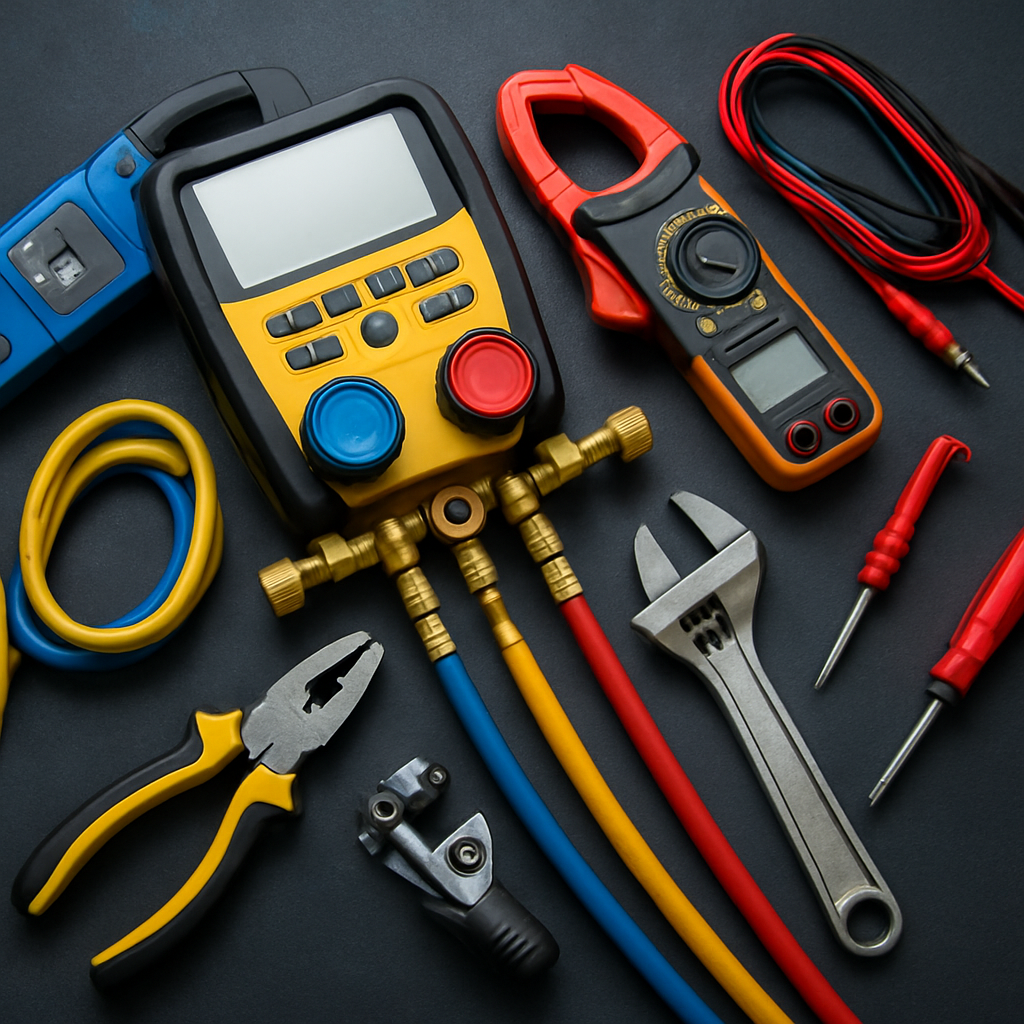
If you run commercial HVAC crews or manage facility procurement, the right hvac tools separate efficient, compliant service from repeated callbacks and regulatory headaches. This must-have checklist names specific models, realistic price ranges, maintenance and calibration guidance, and the safety and EPA compliance notes technicians need for commercial work. You will also get procurement tips for bulk buying, kit organization, and a short pre-shift inspection checklist to keep fleet uptime predictable.
1. Digital Multimeter and Clamp Meter – Fluke 117 and Fluke 323
Essential pair for electrical diagnostics. The Fluke 117 True RMS multimeter and the Fluke 323 True-rms clamp meter cover the electrical checks you will do on commercial panels, starters, transformers, and control circuits without improvisation. Buy them as a matched set for techs who move between rooftops and mechanical rooms all day.
Why these models matter on commercial jobs
Practical strengths. The Fluke 117 gives fast AC/DC voltage checks and noncontact voltage detection while the Fluke 323 measures AC current up to 400 A without breaking the circuit. Together they reduce ladder time and the number of times a tech must open energized panels – that saves time and lowers exposure risk.
- Safety rating: Use meters rated for the job – prefer CAT III or CAT IV when working downstream of service equipment.
- Limitation: The Fluke 323 maxes at 400 A. For large chillers or bus duct work you need flexible current probes or clamp meters with higher range.
- Tradeoff: Fluke 117 is compact and fast but lacks advanced data logging. If you need trending for recurring faults choose the Fluke 289 or a logging-capable meter.
Concrete Example: On a 15 ton rooftop unit the tech used the Fluke 323 to capture motor inrush at startup and the Fluke 117 to verify contactor coil voltage and control transformer output. The clamp caught a 6x inrush spike that the panel fuses barely tolerated, and the DMM confirmed a 10 percent low control voltage that explained nuisance tripping.
Maintenance and fleet considerations. For multi-tech crews schedule annual calibration for meters that see heavy use and log serial numbers for warranty claims. Keep spare test leads, fresh batteries, and a clear policy that meters showing erratic readings get pulled from service immediately.
Buy meters through an authorized distributor to preserve warranty and calibration options; see procurement options at Hubzone Depot and model details at Fluke.
2. HVAC Manifold Gauge Sets with Digital Readout – Yellow Jacket 49973N and Fieldpiece SM480V
Direct point: Digital manifolds are no longer a luxury on commercial calls; they shorten the path from diagnosis to correct charge when used with proper accessories. The Yellow Jacket 49973N and Fieldpiece SM480V are solid picks because they combine precise pressure sensors with on-board superheat/subcooling help — but they are tools with limits, not magic boxes.
How they actually change the workflow
Practical benefit: With accurate pressure readings on-screen and built-in charge calculators you eliminate a paper-and-calculator step. That matters on 5+ ton rooftop and split systems where small refrigerant errors multiply into repeated callbacks and tenant complaints.
Concrete Example: A tech commissioning a 12-ton rooftop unit used the Fieldpiece SM480V to read suction and discharge pressures and a separate probe for suction line temperature. The digital readout gave immediate superheat values while the charging scale tracked mass — the job finished on schedule because adjustments were made to a single decimal point rather than by educated guesswork.
- Pre-purchase checklist: sensor accuracy specification, replaceable sensor modules, battery type and runtime, hose rating (600 psi minimum for most commercial work), and whether ball valves are included to limit refrigerant loss.
- Deployment checklist: pair the manifold with a
charging scale, independent thermocouples or clamp-on temp probes, and service hoses with low-permeation cores to avoid refrigerant loss on long runs. - Fleet procurement tip: choose models with factory calibration options and keep a spare manifold or sensor head per truck to avoid downtime.
Trade-off to accept: Digital displays give precise snapshots; analog needles give real-time motion. On systems with rapid pulsing or short cycling an analog gauge can reveal transient behavior digital averaging smooths out. For commercial fleets I recommend carrying both a digital manifold and a compact analog set or at least a sight glass-style reference on the rig.
Maintenance realities: Expect digital sensors to drift with age and rough handling. Schedule annual calibration for high-use units and budget for replacement sensor cartridges rather than retiring the whole manifold. Replace hose O-rings and ball-valve seats on a yearly cadence and keep battery spares or choose rechargeable models to simplify logistics.
Compliance note: Never rely on manifold readout alone for recordkeeping where EPA or client documentation is required. Combine manifold readings with a certified charging scale and recovery logs; store serial numbers and calibration certificates in fleet records or in your procurement system at Hubzone Depot.
Final judgment: If your procurement priority is reliability and uptime, choose digital manifolds with replaceable sensor modules, confirm local factory calibration support, and insist on kits that include ball valves and dedicated thermocouple ports. That combination pays back quickly on commercial jobs where accuracy and speed control labor and refrigerant costs.
3. Refrigerant Recovery Machine and Vacuum Pump – Robinair VacuMaster 15500 and Yellow Jacket BlueVac 6 CFM
Bottom line: For commercial service you need a certified recovery machine plus a solid vacuum pump; the Robinair VacuMaster 15500 and the Yellow Jacket BlueVac 6 CFM are a practical pairing because one handles fast refrigerant pull and the other achieves the deep vacuum that prevents moisture-related failures. Choose them for reliability, serviceability, and parts availability rather than lowest upfront cost.
Matching tool capacity to job demands
Sizing reality: A 6 CFM vacuum pump clears moisture quickly on 3–15 ton rooftop and split systems; it is not a one-size-fits-all solution for chillers or industrial racks. For systems above ~30 tons plan for staged pumping, a 10–12 CFM pump, or rigging parallel pumps to hit micron goals in reasonable time.
- Selection factors: refrigerant compatibility, recovery rate (lbs/min), oil management and filter driers, service parts availability, and whether the unit has integrated gauges or data ports.
- Operational trade-off: faster recovery machines are heavier and more complex; if your crews do many rooftop swaps a midweight, easily serviceable unit beats a fragile high-speed cart.
- Vacuum trade-off: oil-sealed, two-stage pumps get lower microns and tolerate a bit of contamination; single-stage pumps are lighter and cheaper but stall out on wet circuits.
Maintenance that matters: Change vacuum pump oil after any contaminated pull and then on a scheduled interval tied to runtime hours. Keep inlet screens and coalescing filters clean on the recovery machine and buy spare filter cartridges before you need them — downtime on refrigerant work stalls an entire crew.
Real-world application: A tech recovering R-410A from a 20-ton rooftop unit used the Robinair VacuMaster 15500 to recover refrigerant into an approved cylinder and then switched the Yellow Jacket BlueVac 6 CFM on the service manifold. After a 20 minute pump down the micron gauge held under 250 microns; a triple-evacuation (break vacuum with dry nitrogen twice) resolved persistent moisture after a brazing repair and prevented a compressor failure on recharging.
Common mistake: Teams buy a single large recovery cart assuming it solves everything. In practice you need a vacuum strategy — micron gauge, staged evacuations, and an oil-management plan — not just raw recovery speed. Calibration of the micron gauge and documented hold tests are where many shops fall short.
Use a certified recovery machine and keep vacuum metrics (microns and hold times) recorded in your work log to meet compliance and avoid costly callbacks.
Next consideration: Before purchasing, verify local EPA and state refrigerant handling requirements at EPA Section 608 and buy units that support the refrigerants your crews service today and are likely to encounter in the next three years.
4. Electronic Leak Detector and Ultrasonic Leak Detector – Robinair LD7 and UEi DL479
Direct point: Electronic and ultrasonic detectors serve different detection physics and should be bought and deployed as a paired strategy rather than as alternatives. The Robinair LD7 is a sensitive halogen refrigerant sniffer while the UEi DL479 reads airborne ultrasonic signatures from pressurized leaks and mechanical sources. Using both eliminates the blind spots each technology has.
When to choose which detector and why
Practical insight: Use the Robinair LD7 for low ppm refrigerant traces around coils, fittings, and service ports because it responds to halogen molecules directly. Use the UEi DL479 when you need to locate hissing leaks in pressurized lines, leaky service valves, or when the system is under charge and the sound signature is clearer than the chemical plume. Ultrasonic detectors are also useful for non refrigerant leaks such as compressed air and steam.
Limitation and tradeoff: Electronic sniffers lose effectiveness with certain low-GWP blends and HFO mixes unless the detector supports those chemistries. Ultrasonic detectors do not measure concentration and cannot prove refrigerant presence. Expect false positives from oil or cleaning agents on electronic tips and from HVAC ambient noise on ultrasonic pickups. Plan procurement around replacement sensors, training, and spare tips rather than the lowest price unit.
- Field checklist for leak tracing: Zero and warm up the LD7 before scanning coils, sweep slow with the tip 2 to 5 mm from joints, and back off to confirm a rising trend rather than a single spike
- Ultrasonic technique: Use the DL479 with the parabolic attachment in noisy mechanical rooms and switch to the contact adapter on pipe clamps to confirm source direction
- Verification step: After locating a suspect leak, perform a pressure hold test or use a soap solution plus a second detection method to confirm repair action
Concrete example: A technician servicing a multi-tenant rooftop unit scanned condenser tube rows with the Robinair LD7 and flagged a slow leak at a factory flare. The LD7 showed a faint but consistent rise when moving along the joint. To be certain the sound matched a pressurized escape, the tech switched to the UEi DL479, detected a distinct ultrasonic hiss at the same location, performed a pressure hold, replaced the flare o ring, and rechecked with both tools before paperwork.
Judgment that matters: Many teams expect leak detectors to be plug and play. In practice batteries, sensor life, contamination, and refrigerant chemistry matter more than brand alone. Buy detectors with accessible sensor cartridges, order spares at purchase, and require techs to log detector bump tests. For compliance retain records of leak detection, repair, and retest in the job file to support EPA Section 608 audits.
{
“@context”: “https://schema.org”,
“@type”: “BlogPosting”,
“mainEntityOfPage”: {
“@type”: “WebPage”,
“@id”: “https://shop.hubzonedepot.com/hvac-tools-checklist-commercial-technicians”
},
“headline”: “Essential HVAC Tools Checklist for Technicians”,
“description”: “Discover must-have HVAC tools for commercial technicians. Ensure efficiency with our comprehensive checklist. Shop now at Hubzone Depot.”,
“image”: {
“@type”: “ImageObject”,
“url”: “https://example.com/featured-image.jpg”,
“height”: 800,
“width”: 1200
},
“author”: {
“@type”: “Person”,
“name”: “Elisa”
},
“publisher”: {
“@type”: “Organization”,
“name”: “Hubzone Depot Shop”,
“logo”: {
“@type”: “ImageObject”,
“url”: “https://shop.hubzonedepot.com/logo.jpg”,
“width”: 600,
“height”: 60
}
},
“datePublished”: “2023-10-15T08:00:00+00:00”,
“dateModified”: “2023-10-15T08:00:00+00:00”
}
article blockquote,article ol li,article p,article ul li{font-family:inherit;font-size:18px}.featuredimage{height:300px;overflow:hidden;position:relative;margin-top:20px;margin-bottom:20px}.featuredimage img{width:100%;height:100%;top:50%;left:50%;object-fit:cover;position:absolute;transform:translate(-50%,-50%)}article p{line-height:30px}article ol li,article ul li{line-height:30px;margin-bottom:15px}article blockquote{border-left:4px solid #ccc;font-style:italic;background-color:#f8f9fa;padding:20px;border-radius:5px;margin:15px 10px}article div.info-box{background-color:#fff9db;padding:20px;border-radius:5px;margin:15px 0;border:1px solid #efe496}article table{margin:15px 0;padding:10px;border:1px solid #ccc}article div.info-box p{margin-bottom:0;margin-top:0}article span.highlight{background-color:#f8f9fb;padding:2px 5px;border-radius:5px}article div.info-box span.highlight{background:0 0!important;padding:0;border-radius:0}article img{max-width:100%;margin:20px 0}